Introduction
Walk into any dispensary and the menu is split into three columns: indica, sativa, hybrid. It's the first thing every budtender explains to a first-time customer. You point at the menu, they give you the rundown — indicas for relaxation, sativas for energy, hybrids for somewhere in between. Simple enough.
But here's the thing. That system is based on plant morphology — how the plant grows, the shape of its leaves, how tall it gets, how long it takes to flower. It was never designed to tell you how you'd feel after smoking it. The real drivers of cannabis effects are cannabinoids and terpenes, not whether the plant was short and bushy or tall and lanky.
That doesn't mean the labels are useless. They give you a rough starting point, and most budtenders use them as shorthand because they work well enough for most people most of the time. But if you want to actually understand what's happening — why one strain knocks you out and another has you reorganizing your kitchen at midnight — you need to look past the label.
This article breaks down where the indica/sativa/hybrid system came from, why it's incomplete, and what you should actually pay attention to when picking a strain. Whether you're brand new to cannabis or you've been smoking for years but never thought much about the science, there's something here for you.
The Traditional Classification
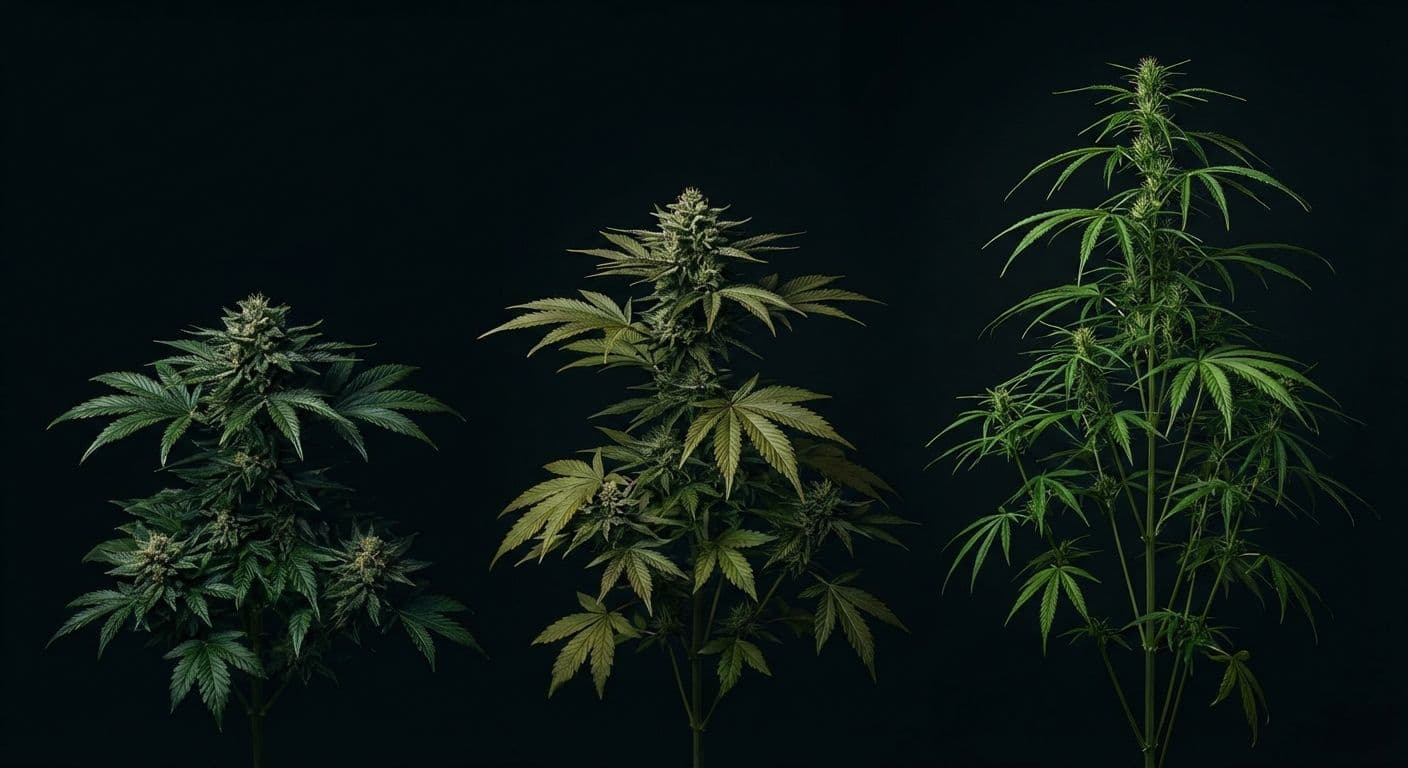
The indica/sativa split goes back further than most people realize. In 1785, a French biologist named Jean-Baptiste Lamarck classified Cannabis indica as a distinct species from Cannabis sativa, which had already been described by Carl Linnaeus. Lamarck was looking at plants from India — the Hindu Kush region specifically — and they looked different from the hemp plants Europeans were already growing. Shorter, bushier, broader leaves. That physical difference is where the entire classification started.
Indica
Indica plants originally came from the mountainous regions of Central Asia — Afghanistan, Pakistan, northern India. They adapted to harsh climates with shorter growing seasons, which is why they tend to be compact, bushy, and fast-flowering. Broad, dark green leaves. Dense buds. They finish flowering in 6 to 8 weeks, which made them popular with growers.
The traditional association is with body effects: deep relaxation, muscle relief, sedation. You've probably heard the mnemonic "in-da-couch" — as in, you'll end up glued to the sofa. And plenty of strains labeled indica do exactly that. But not because they're indica. Because of their specific chemical profile, which we'll get into.
Sativa
Sativa plants evolved in equatorial regions — Southeast Asia, Central America, Africa. Longer growing seasons meant they could take their time. Tall plants, sometimes over 12 feet, with narrow, light green leaves and airy buds. Flowering takes 10 to 16 weeks, which is a pain for commercial growers but produces distinct genetics.
The traditional reputation is cerebral: energy, creativity, focus, a "head high." People reach for sativas when they want to be productive, social, or creative. And again, many sativa-labeled strains deliver on that promise. But the reason isn't the plant's height or leaf shape. It's the terpenes.
Hybrid
Here's the reality that complicates the whole system: almost everything you'll find at a dispensary is a hybrid. Decades of crossbreeding have blurred the genetic lines almost completely. Breeders aren't selecting for "pure indica" or "pure sativa" — they're selecting for specific traits. Flavor, potency, yield, flowering time, terpene expression. A strain might be 70% indica genetics but express terpenes that give you an energetic, clear-headed experience.
Pure landrace strains — the original genetics from specific geographic regions — still exist, but they're rare in the commercial market. What you're buying is the product of sophisticated breeding programs that mix and match genetics across the old indica/sativa divide.
Why the System Is Outdated
Let's be blunt about it: the science doesn't support using indica and sativa as predictors of effect. That's not a fringe opinion. It's the consensus among cannabis researchers.
Dr. Ethan Russo — one of the most respected cannabis researchers in the world — published influential work in 2016 calling the indica/sativa distinction "total nonsense" when it comes to predicting effects. His argument: the chemical composition of a plant (its cannabinoid and terpene profile) is what determines how it makes you feel. Two plants both labeled "indica" can have wildly different terpene profiles and produce completely different experiences.
Think about it this way. Imagine you're at a wine shop and every bottle is labeled either "red" or "white." That tells you something, but not much. A light Pinot Noir and a heavy Cabernet are both "red," but they're completely different experiences. The grape variety, the terroir, the winemaking process — those details matter more than the color. Cannabis is the same way. The indica/sativa label is the equivalent of "red or white." It's a start, not an answer.
Modern genetic analysis backs this up. Studies have shown that the genetic differences between plants labeled "indica" and "sativa" don't reliably correlate with their chemical profiles. A strain sold as sativa might have the same terpene profile as something sold as indica down the street. The categories are based on how the plant looks, not what it does.
So why do the labels persist? Because they're simple. Dispensary menus need categories. Budtenders need a quick way to guide new customers. And for many casual consumers, the system works well enough — they buy an indica, they feel relaxed, they're satisfied. The problem comes when you assume the label is the whole story. It's not even close.
Educated consumers are starting to look deeper. And the industry is slowly catching up. But we're in a transition period where the old system and the new science coexist. Understanding both puts you ahead of most people walking into a dispensary.
What Actually Determines Effects
If the indica/sativa label isn't the answer, what is? Two things: cannabinoids and terpenes. These are the chemical compounds in the plant that interact with your body to produce effects. Everything else is secondary.
Cannabinoids
THC is the primary psychoactive compound — the one responsible for the "high." Higher THC means a more intense experience, but more isn't automatically better. A 30% THC strain can be overwhelming for someone whose sweet spot is 18%. It's like alcohol: a double IPA isn't objectively better than a session ale. It depends on what you're looking for.
CBD is non-psychoactive and modulates how THC affects you. A strain with 15% THC and 5% CBD will feel noticeably different from one with 15% THC and 0% CBD. The CBD smooths out the experience — less anxiety, less racing thoughts, more body relaxation. This is why the THC:CBD ratio matters at least as much as the raw THC number.
Then there are the minor cannabinoids — compounds present in smaller amounts that still influence the experience. CBG shows potential for focus and mental clarity. CBN is associated with sedation and often shows up in aged cannabis. CBC and THCV are less studied but contribute to the overall effect. Think of these as the supporting cast — they're not the lead, but they shape the performance.
Terpenes: The Real Story
If you take one thing from this article, let it be this: terpenes are the biggest factor in how a strain makes you feel. They're aromatic compounds found in all plants — not just cannabis — and they have real, measurable effects on your body and mood. When someone says a strain "smells like pine" or "tastes citrusy," they're describing terpenes. And those same terpenes are influencing the experience.
Myrcene is the most common terpene in cannabis. Earthy, musky, a little herbal. You'll find it in mangoes, hops, and lemongrass too. Myrcene is strongly associated with relaxation and sedation. Strains high in myrcene tend to feel "indica-like" regardless of their genetic classification. If a strain knocks you out, there's a good chance it's loaded with myrcene.
Limonene smells like citrus — because it's the same compound that makes lemons smell like lemons. It's associated with elevated mood and stress relief. Strains high in limonene tend to feel more uplifting and clear-headed. If you've ever had a strain that put you in a great mood without making you drowsy, limonene was probably driving that.
Pinene smells like a walk through a pine forest. It's associated with alertness and may help with memory retention — there's research suggesting it counteracts some of THC's short-term memory effects. Found in pine needles, rosemary, and basil. A strain with high pinene often feels focused and sharp.
Caryophyllene is the spicy, peppery terpene — think black pepper and cloves. It's unique because it's the only terpene that also acts directly on cannabinoid receptors (specifically CB2). That gives it anti-inflammatory properties that other terpenes don't have. If you've ever heard that chewing a black peppercorn can reduce cannabis-induced anxiety, caryophyllene is why.
Linalool is the lavender terpene. Floral, calming, associated with anti-anxiety effects. Strains high in linalool tend to be relaxing without being sedating — a calm alertness rather than a couch-lock.
Terpinolene is herbal and slightly floral with a piney undertone. It's less common than the others but shows up in many classic "sativa" strains like Jack Herer and Dutch Treat. Strains with dominant terpinolene often have that uplifting, creative quality people associate with sativas.
The Entourage Effect
None of these compounds work in isolation. Cannabinoids and terpenes interact with each other — and with your body's endocannabinoid system — to produce a combined effect that's different from any single compound alone. Researchers call this the entourage effect.
This is why a 20% THC strain with a rich, diverse terpene profile can feel more potent and more interesting than a 30% THC strain that's been bred purely for potency at the expense of everything else. The full chemical profile matters. Chasing the highest THC number is like choosing wine based only on alcohol percentage — you're missing the point.
A Better Way to Choose
So if you're standing in a dispensary looking at 40 different products, what should you actually do? Here's a practical framework that works better than just asking for an indica or a sativa.
Start with the effect you want. This sounds obvious, but most people skip it. Do you want to relax? Sleep? Get creative? Be social? Manage pain? Start with the outcome and work backward. Instead of saying "I want an indica," say "I want something that'll help me unwind after work without putting me to sleep." That gives your budtender something specific to work with.
Check the terpene profile. More products are listing terpene data on the label or on the dispensary's website. If you see high myrcene, expect relaxation. High limonene or terpinolene, expect energy. High linalool, expect calm without sedation. The terpene profile tells you more than the indica/sativa label ever will.
Consider the THC:CBD ratio. If you want a milder, more controlled experience, look for strains with some CBD in the mix. A 1:1 THC:CBD ratio is noticeably different from a 20:1 ratio. The CBD takes the edge off and adds body relaxation without the intensity.
Ask about the specific batch. Cannabis is an agricultural product. The same strain grown by different cultivators, or even the same strain from the same grower in a different harvest, can express different terpene profiles. Environmental factors — light, temperature, nutrients, curing process — all affect the final product. Good dispensaries test each batch and can tell you what's in the specific product on the shelf.
Start low and go slow. Regardless of what the label says, if you're trying a new strain, ease into it. Take a small amount, wait, and see how it hits you. Your body chemistry is unique. What works for your friend might not work the same way for you. Build your personal catalog of strains you know and trust.
How Dr. Greenthumb Approaches This
DGT products are developed with terpene profiles as a primary consideration — not an afterthought. The brand works with specific genetic lines, including the Barney's Farm partnership genetics and signature strains like Insane OG, where the terpene expression is consistent and well-characterized across harvests.
When you pick up a Dr. Greenthumb product, the experience is predictable because the genetics are proven, the growing conditions are controlled, and the terpene profiles are tested. That's the difference between a brand that views cannabis as a commodity and one that views it as a craft product. You know what you're getting before you open the jar.
The Future of Cannabis Classification
The industry knows the indica/sativa system is limited. The question is what replaces it. Several approaches are emerging, and they're all pointing in the same direction: effects-based classification powered by chemical data.
Leafly, one of the largest cannabis platforms, has experimented with grouping strains by effect and flavor rather than indica/sativa/hybrid. Instead of three categories, they use a spectrum that accounts for terpene dominance, THC:CBD ratio, and reported consumer effects. It's more complex, but it's more accurate.
Some dispensaries are already moving to terpene-forward menus. Instead of sorting products by indica/sativa, they group them by dominant terpene or by effect category — "relaxing," "energizing," "creative," "sleep." Customers who've used these menus consistently say they get better results than the old system gave them.
Lab testing is getting more sophisticated too. Full cannabinoid and terpene profiles are becoming standard on packaging in mature markets like California and Colorado. Five years ago, you were lucky to see THC and CBD percentages. Now, many products list individual terpene concentrations. That data gives consumers real information to work with.
The bottleneck is consumer education. Most people still think in indica/sativa terms because that's what they learned first, and it's what dispensary menus reinforce. Changing how millions of people think about a product category takes time. But the shift is happening. Articles like this one are part of it.
Realistically, the indica/sativa/hybrid labels will stick around for years. They're embedded in state regulations, dispensary point-of-sale systems, and consumer expectations. But the conversation is shifting underneath those labels. The people who understand the chemistry will make better choices, have better experiences, and waste less money on products that don't do what they expected.
The Bottom Line
The indica/sativa/hybrid system isn't worthless — it gives you a rough starting point, and that's fine. But if you want to predict your experience with any real accuracy, look at the terpene and cannabinoid profile. Ask questions at the dispensary. Pay attention to how specific strains affect you personally, and keep notes if you're serious about it.
Cannabis affects everyone differently. Your endocannabinoid system is unique, your tolerance is unique, and the specific product you're consuming is unique to that batch. No label can capture all of that. But understanding what's actually in the plant — the cannabinoids, the terpenes, the full chemical picture — gets you a lot closer to finding what works for you.
The label on the jar is where the conversation starts. Not where it ends.


